The streets
Nights out: the bar street
Kadıköy drinks where it lives. The bars sit between the fishmonger and the record shop, the crowd is mostly local, and the bill is roughly half what you'd pay across the water. Here's how a night here tends to go.
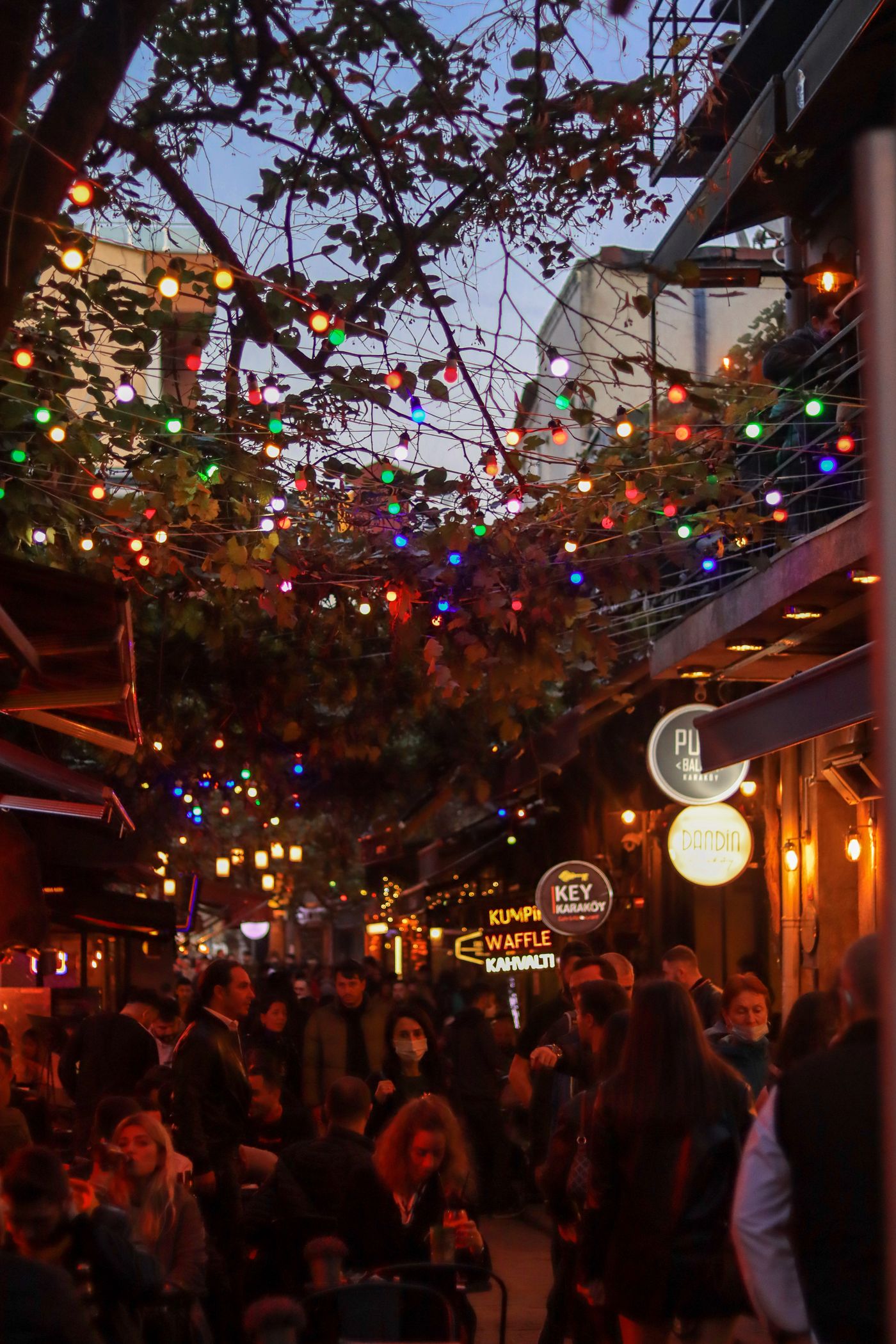
Most people meet "the bar street" before they learn its real name. On the map it's Kadife Sokak, a cobbled lane running off the back of the market toward Moda. Nobody calls it that. Everyone says Barlar Sokağı — the bar street — and on a warm Friday you understand why. Bar after bar after bar, both sides, doors open, and when the rooms fill up the crowd simply moves outside and stands on the cobbles with a beer.
That spill onto the street is the thing to know. The bars are small, often a single low-ceilinged room, so the actual party happens in the lane between them. You drift, you bump into people, you end up three doors down from where you started. It's loud and friendly and a bit chaotic, and it costs very little.
Why it's cheaper, and why that matters
Across the Bosphorus, the streets off İstiklal in Beyoğlu have spent years tilting toward tourists and the prices that come with them. Kadıköy didn't. This is a working neighbourhood on the Asian side, full of students from the nearby universities, and the drinks are priced for people who come out twice a week, not once a holiday.
A large draught here runs you a fraction of a rooftop on the European side. That single fact shapes everything: the crowd skews younger, nobody's rushing you off your stool to turn the table, and a round of beers doesn't end the evening before it starts. If you want the short version of what Kadıköy is, read its neighbourhood history — it's been a place people actually live for a very long time, and it drinks like one.
Beyoğlu is where Istanbul goes to perform a night out. Kadıköy is where it just has one.
The rakı tables that forget to end
Not every night here is a beer-and-shouting night. Plenty of them are slow, and they start at a table.
A proper meyhane meal is its own kind of evening out. You sit down, a waiter brings a tray of cold meze — beans, stuffed vine leaves, smoked aubergine, whatever's good that day — and a bottle of rakı arrives with a jug of water and ice. You pour it cloudy, you eat slowly, and somewhere around the second hour you realise dinner has quietly become drinking. Nobody planned it. The table just kept going.
That's the natural bridge into a Kadıköy night. Finish the meze, settle the bill, and you're already half a glass of rakı in and a two-minute walk from the bars. It's the most local way to start, and far less of a tourist set-piece here than in the better-known meyhane rows.
How to drink rakı without embarrassing yourself: dilute it (roughly half rakı, half water), keep it on the table next to your food rather than knocking it back, and pace it across a long meal. It is strong, anise-heavy, and absolutely not a shot. Sip, eat, talk, repeat.
The music end of things
Kadıköy has a real claim on Turkish guitar music. The Asian side, and Kadıköy in particular, has long been a home base for the country's rock and alternative scene — the rock scene here runs deep, and you feel it in the bars.
So alongside the beer joints there are rock and indie bars where the playlist is the point, and below some of them are basement venues that put on live bands. These don't get going early. A band might not start until well after midnight, which suits the rhythm of the night — eat, drink on the street, then go down some stairs to a sweaty little room and catch a set. If you only do one structured thing on a night out here, make it this.
There's a craft-beer corner too, for people who care about what's in the glass, plus a steady supply of cheap student dives where nobody's trying to impress anyone. The range is wide without being curated to death. You can spend the whole night moving between three very different rooms inside the same block.
A rooftop to finish on
When you need a breather from the lane, go up. A handful of bars in the area have rooftop terraces, and a late drink up there is the easiest way to remember you're in Istanbul and not just a fun crowded street. You get the skyline, the minarets catching the last of the light, the water somewhere off in the dark.
I'd treat the rooftop as a nightcap rather than a base. The energy is all down at street level; the roof is where you go to cool off, hear yourself talk, and decide whether you're heading home or staying out. Most nights, you stay out.
How the night actually flows
If you've come from the European side or from abroad, the timing will feel late. Adjust to it. Here's the honest shape of an average good night:
- Around 21:00 — things start filling. Earlier than that and the lane is half-empty.
- 22:00–01:00 — peak. Bars over clubs; the street is the venue.
- After midnight — the live-music basements come alive.
- Late — the food carts and grills do their best business of the day.
Nobody here is in a hurry, and clubs in the big-room sense aren't really the move. Kadıköy is a bars-and-bands town. Treat it that way and you'll have the right night.
The eating-at-2am part
No Kadıköy night ends sober and upright without food, and the late-night eating is half the fun. The classics are all within stumbling distance of the bars.
There's kokoreç — seasoned grilled lamb intestine chopped on a griddle and stuffed into bread, which sounds alarming and tastes fantastic at one in the morning, so don't ask too many questions. There's the dürüm, a wrap of grilled meat that fixes most things. And there's the ıslak burger — the "wet burger," a small soft bun sitting in a steamed tray of tomato-garlic sauce, glistening under a heat lamp, engineered specifically for the state you'll be in. None of it is fine dining. All of it is exactly right.
Practical bits worth knowing
A few honest notes so the night ends well.
It's a relaxed, mixed crowd and generally easygoing — but it's still a packed street, so keep your phone and wallet somewhere sensible and don't leave a bag hanging open on the back of a chair. Standard big-night common sense, nothing more.
Getting home is the one thing to plan. The ferries across to the European side stop fairly early for a night this late, so if that's your way back, check the last boat before you settle in. Miss it and you've still got options: the Marmaray rail tunnel under the Bosphorus runs late, and a taxi over one of the bridges always works. Just don't assume the ferry will wait for you — it won't.
Thursday through Saturday are the loud nights. Come midweek and it's calmer, cheaper still, and easier to actually talk — which, depending on your mood, might be the better call. Either way, you don't book anything. You walk down from the ferry, you find the lane, and you let it take the evening from there.