Arriving
The ferries across the water
Forget the cruise touts on the Eminönü waterfront. The cheapest boat in Istanbul is also the best one, and it happens to dock right where you want to be.
Here is the thing nobody tells you before you arrive. The famous Bosphorus cruise, the one with the tour boards and the man in the windbreaker asking if you speak English, costs many times what locals pay to cross the same water. You do not need it. The everyday commuter ferry to Kadıköy gives you the same skyline, the same gulls, the same gold light on the domes, and it costs roughly the price of a cup of tea.
It is also the most pleasant way I know to reach Kadıköy. Twenty minutes, give or take. You stand at the back, the European shore slides away behind you, and by the time your tea has cooled enough to drink you are bumping gently into the pier on the Asian side.
The boats, and who runs them
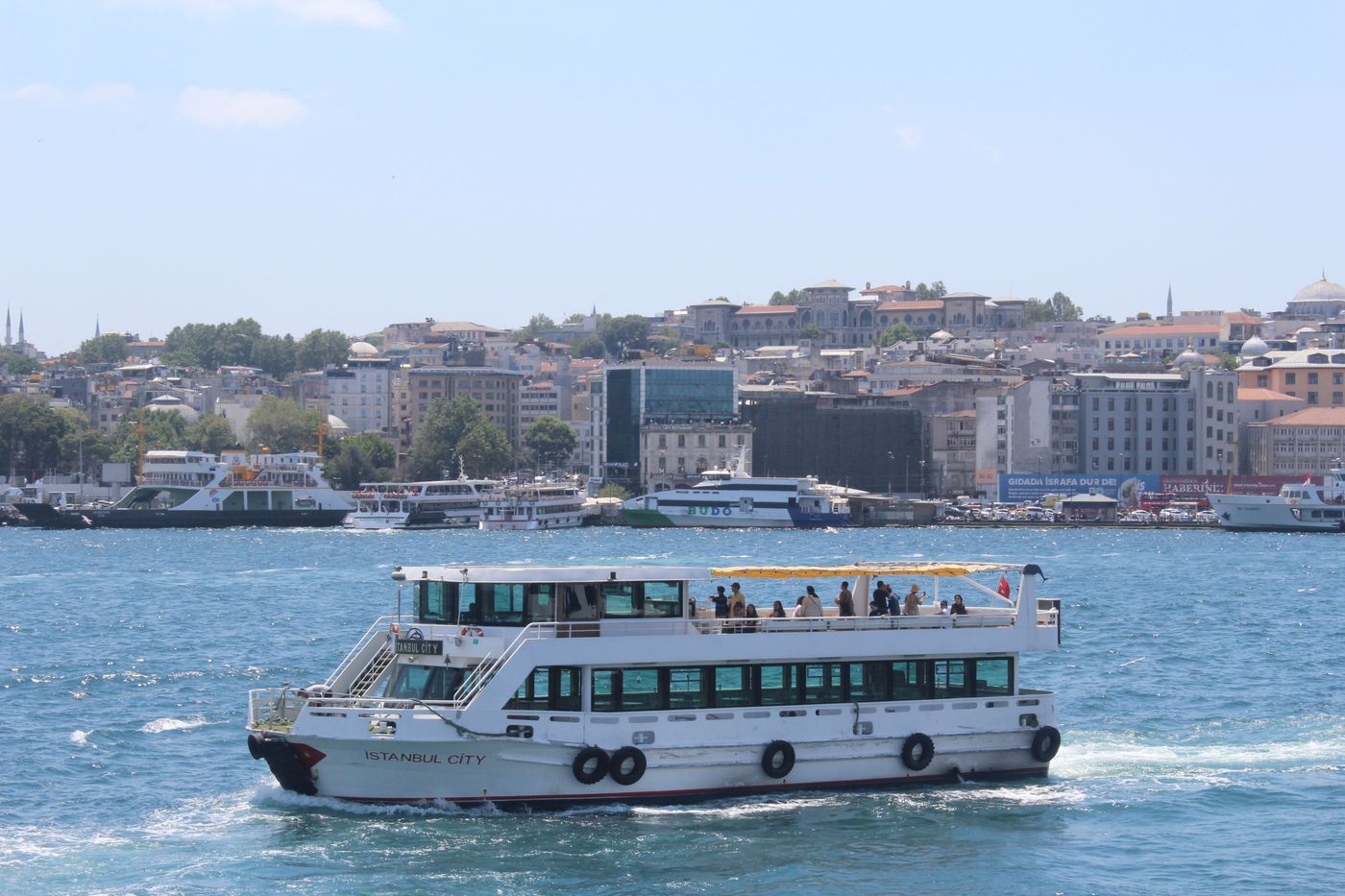
Two kinds of operator share these routes, and for your purposes the difference barely matters. Public ferries belong to Şehir Hatları, the city line, the old white-and-cream boats with the funnels that everyone photographs. Private companies, mainly Turyol and Dentur Avrasya, run smaller craft on overlapping routes. They leave from slightly different jetties, sometimes a few minutes apart, and all end up at the same place.
From the European side, the crossings that matter run out of Eminönü, Karaköy and Beşiktaş, with another from Kabataş. Eminönü is the obvious one from the old city, Sultanahmet way. Karaköy suits you after a wander around Galata. Beşiktaş is your jetty if you are near Taksim and walked down the hill. All of them land at the Kadıköy iskele, the terminal, a handsome stone-and-tile building that has been shuffling passengers across for well over a century.
The cheapest boat ride in Istanbul is the one the commuters take. Everything the tour boat sells you, the working ferry gives away for the price of a tram fare.
Paying, which takes two seconds
You need an İstanbulkart, the rechargeable card that runs the whole transport network. Buy and top one up at any of the yellow machines by the turnstiles. Tap it on the reader as you go through the gate, walk down to the boat, done. No paper ticket, no queue at a desk, no negotiating. A single ferry hop costs a fraction of what a tourist cruise charges, and the card pays for itself within an afternoon because it works on the trams, metro, buses and Marmaray too.
One card, everything. The same İstanbulkart you tap for the ferry opens the turnstiles on the tram, the metro and Marmaray. Top it up before you set out so you are not feeding coins into a machine while a boat fills up behind you. Transfers within a couple of hours come discounted, which the cruise sellers will never mention.
One small warning. If a desk quotes you a price in euros for a "scenic Bosphorus tour", you are at the wrong window. Commuter ferries do not work that way. Walk past, find the turnstiles, tap your card.
How often, and how late
Often enough that you should not bother with a timetable too hard. On the busy crossings a boat leaves every fifteen to thirty minutes, with more at the morning and evening rush when half of Kadıköy is commuting to the other side and back. First boats are out around half past six; the last ones run into the late evening, though the final departure depends on the route and operator.
If you want the timings to the minute, the city line Şehir Hatları publishes its schedules, and the transport authority keeps the network maps current on the municipality site. Honestly, though, I have never once planned a ferry. You turn up, you wait less than half an hour, you go.
The deck ritual
This is the part I actually came to write about. The boat is not just transport; it carries a whole small culture on board, and missing it would be a shame.
Go straight for the open deck at the back. Do not sit inside in the warm cabin like a sensible person. On most public boats a man works the deck with a tray, selling glasses of çay, proper Turkish tea in tulip glasses, two coins each. Buy one. Then grab a simit, the sesame bread ring, from the kiosk on the pier before you board.
Now the gulls. They know exactly what a ferry is and what a simit is, and they fall into formation behind the boat the moment it leaves the pier, hanging there in the slipstream at arm's length, waiting. Tear off a piece, hold it up, and one takes it clean out of your fingers. Children lose their minds over this. So do adults who pretend they are above it.
Tea in one hand, simit in the other, gulls at your shoulder, the old city sliding past on the rail. That is the crossing. People pay a great deal of money for a worse version of it.
What you see on the way
Leaving from Eminönü or Karaköy, the view back over your shoulder is the postcard everyone knows, except you are getting it for free and from the water, which is the right angle. Minarets and the great grey dome of Hagia Sophia. Topkapı sitting on its point above the trees. Galata Tower up on the hill on the far bank. As the boat swings out, the whole skyline rearranges itself, and somewhere mid-channel you get the version of Istanbul that ends up framed on people's walls.
Ahead, the Asian side comes up more quietly, lower and greener, the Kadıköy waterfront and the Moda headland off to the right. Less dramatic, somehow more reassuring, the city you are about to walk into rather than the one you are leaving.
Go at sunset
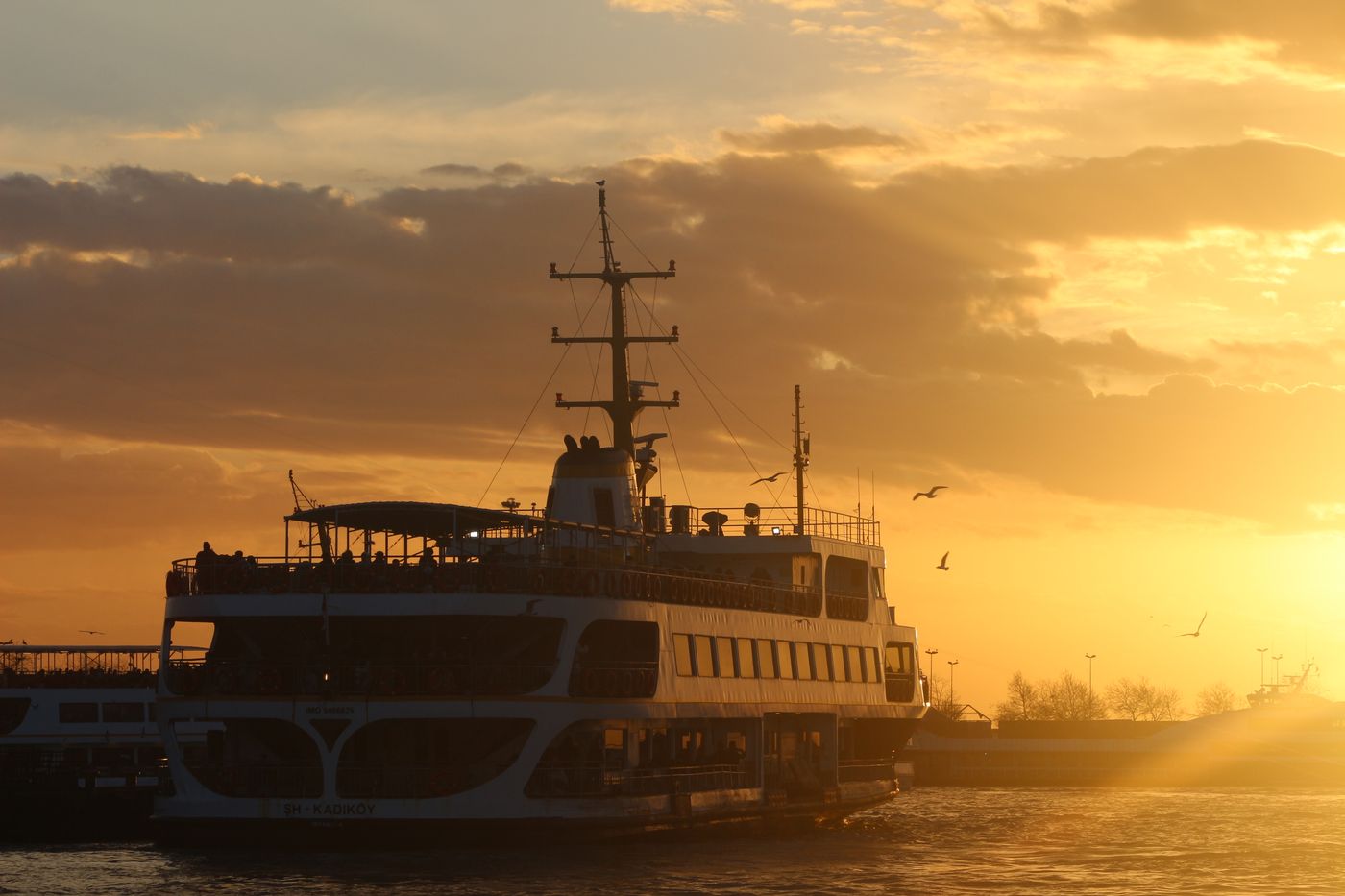
If you take one crossing and one only, make it the evening one, heading west to east as the sun drops behind the old city. The light goes copper, then properly gold, setting the domes and the water and the gulls on fire at once. That cover photo up top is exactly it, a Kadıköy ferry caught mid-crossing in the last of the light, and it is no trick of the camera. I have done the sunset run more times than I can count, and it has never once been ordinary.
My tip: time the evening boat for roughly twenty minutes before sunset. The crossing takes about that long, so you get the gold light building the whole way over and you step off at Kadıköy just as it tips into dusk, right when the bars along the water are turning their lights on.
When the boats don't run
One catch worth knowing. When the lodos blows, the strong south wind off the Sea of Marmara, the channel gets rough and the ferries are cancelled, sometimes for the better part of a day. It is rare, but when it happens it can strand you on the wrong shore, watching empty piers.
This is where the train earns its keep. Marmaray is the rail line that runs in a tunnel under the Bosphorus, connecting the two continents below the seabed. It is fast, frequent, and indifferent to the weather. From the European side you board at Sirkeci or Yenikapı and come up on the Asian side at Ayrılık Çeşmesi, a short walk or a single tram stop from the heart of Kadıköy. Four minutes under the water and you are across.
| Crossing | Roughly how long | Best for |
|---|---|---|
| Public ferry (Şehir Hatları) | ~20 min | The view, the tea, the whole experience |
| Private ferry (Turyol / Dentur) | ~20 min | When a public boat just left and one of theirs is going |
| Marmaray (undersea train) | ~4 min under the water | Bad weather, a hurry, or after the last boat |
So that is the calculus, and it is not complicated. Take the ferry whenever you can, because it is one of the genuine pleasures of being in this city and it costs almost nothing. Keep Marmaray in your back pocket for the lodos days and the late nights. Either way you end up in Kadıköy, which is the whole point, and only one of the two involves a gull eating out of your hand.
Get the tea. Stand at the back. You will understand the moment the gulls show up.